StackAI
StackAI is in beta. Capabilities, suggested prompts, and enabled tools may vary by tenant. Confirm with StackConsole which features are active on your deployment.
StackAI is the cloud operations assistant inside the customer cloud console. End users describe what they want in plain language — list VMs, check billing, take a snapshot — and StackAI carries out the work against their live account.
They do not need API calls, deep menus, or command names. Type a request, confirm when asked, and StackAI executes.
Where customers open it
- Sign in to the cloud console (same dashboard used for instances, networks, and billing).
- In the left sidebar, under General, click StackAI.
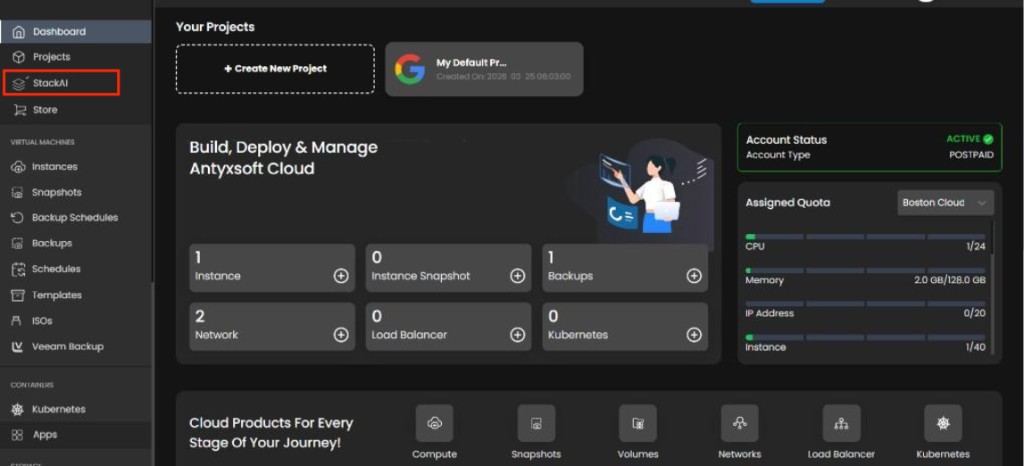
StackAI uses the existing session — there is no separate login.
Architecture overview
StackAI connects natural-language user requests to cloud infrastructure through a strict, controlled multi-tier pipeline:
┌──────────────┐
│   End User   │
└──────┬───────┘
       │ Natural-language request
       ▼
┌──────────────┐
│   StackAI    │
│  UI + Agent  │
└──────┬───────┘
       │ Tool invocation
       ▼
┌──────────────┐
│   Internal   │
│ OpenAPI/Tool │
└──────┬───────┘
       │ API invocation
       ▼
┌──────────────┐
│   CMP API    │ ◄── Enforces AuthN, RBAC, Tenant Isolation & Quotas
│ Auth/Policy  │
└──────┬───────┘
       │ Provider abstraction
       ▼
┌──────────────┐
│ CMP Provider │
│ Integration  │
└──────┬───────┘
       │ CloudStack API
       ▼
┌──────────────┐
│  CloudStack  │
│     API      │
└──────┬───────┘
       │ Infrastructure provisioning
       ▼
┌──────────────┐
│ Cloud Infra  │ (Zones, Pods, Clusters, VMs, Storage, Networks)
└──────────────┘
The response travels back through the same layers:
Cloud Infrastructure → CloudStack API → CMP Integration → CMP API → Internal OpenAPI/Tool → StackAI Agent → StackAI UI → End User.
StackAI is the conversational intelligence layer. Internal OpenAPI/tools expose controlled capabilities. CMP is the authoritative application, authorization, tenant, and orchestration layer. CloudStack is the underlying infrastructure provider. StackAI must not bypass CMP to directly operate CloudStack.
For the complete architectural specification, component breakdown, read and mutating request lifecycles, sequence diagrams, security boundaries, multi-orchestrator model, audit flows, and error handling, see StackAI Architecture & End-to-End Workflow.
Documentation
| Page | Purpose |
|---|---|
| StackAI Architecture | Architectural layers, component responsibilities, end-to-end request lifecycles, sequence diagrams, security boundaries, and multi-orchestrator model |
| StackAI User Guide | Full tutorial — tour, workflow, examples, history, projects, safety, capabilities, FAQ |
| Production Requirements | OpenAI billing and API key setup for production deployments |
| StackAI Roadmap | What's live, in progress, planned, and under exploration |
Admin notes
| Topic | Detail |
|---|---|
| Production setup | OpenAI account, billing, and API key — see Production Requirements |
| Audience | End customers (not CMP admin console) |
| Architecture | Mediated through CMP API — see StackAI Architecture |
| Permissions | StackAI only lists and changes resources the logged-in user may manage; authorization is enforced exclusively by CMP |
| vs console dashboard | The Customer Dashboard home shows counts, quotas, and product shortcuts; StackAI is the conversational workspace for the same account |
| Not supported in StackAI | Kubernetes, DBaaS, load balancers, VPN — use main console menus where the provider offers them |