Architecture Overview
CMP (Cloud Management Platform) provides a unified, API-driven self-service portal for managing multiple infrastructure providers. Providers are reached only through orchestrator adapters — CMP never talks to CloudStack, OpenStack, or VMware APIs directly from the presentation layer.
Primary providers: Apache CloudStack, OpenStack, VMware vSphere, Proxmox
Optional infrastructure services: Ceph Storage, Veeam VSPC, PowerDNS
Extensibility: New providers follow a standard workflow, but require changes across presentation, application, business services, and orchestrator adapters — not the adapter alone.
This page is organized for different audiences:
| Section | Audience |
|---|---|
| High-level architecture | Business, sales, customers, introductions |
| Component architecture | Developers, solution architects |
| Request lifecycle | Developers, integrators |
| Deployment architecture | Operations, infrastructure, DevOps |
For where to host CMP (single server, multi-server, HA), see Choosing a Hosting Topology.
Architecture diagrams can be hard to read inline. Click a diagram, or use Open full size, to view it in a new browser tab.
Architecture principles
CMP uses a strict layered model. Traffic and control flow top-down; infrastructure never calls the portal.
| Layer | Name | Responsibility |
|---|---|---|
| 1 | Presentation | Customer Portal (React / Next.js), responsive self-service UI |
| 2 | Application | CMP API — REST, authentication, authorization (RBAC), business logic, validation, audit logging |
| 3 | Business services | Domain modules (billing, VMs, networks, storage, orders, and related services) |
| 4 | Orchestrator adapters | Provider-specific API abstraction (CloudStack, OpenStack, VMware, future providers) |
| 5 | Cloud infrastructure | Provider control planes, zones, and optional services (Ceph, Veeam VSPC, PowerDNS) |
CMP has a standard integration workflow, but onboarding a new cloud provider is not limited to the adapter alone.
You typically need coordinated work across:
| Layer | Typical changes |
|---|---|
| Presentation | Portal flows, labels, provider-specific options or screens where the UI must expose the new service |
| Application | API contracts, auth/permissions, validation, and audit for new operations |
| Business services | Packages, quotas, billing rules, orders, and domain logic for the new provider |
| Orchestrator adapters | Provider-specific API mapping (required for all infrastructure calls) |
Adapters keep provider APIs behind Layer 4, but the product still needs end-to-end wiring from portal through business services before customers can use the new provider.
CMP High-Level Architecture
Architecture overview
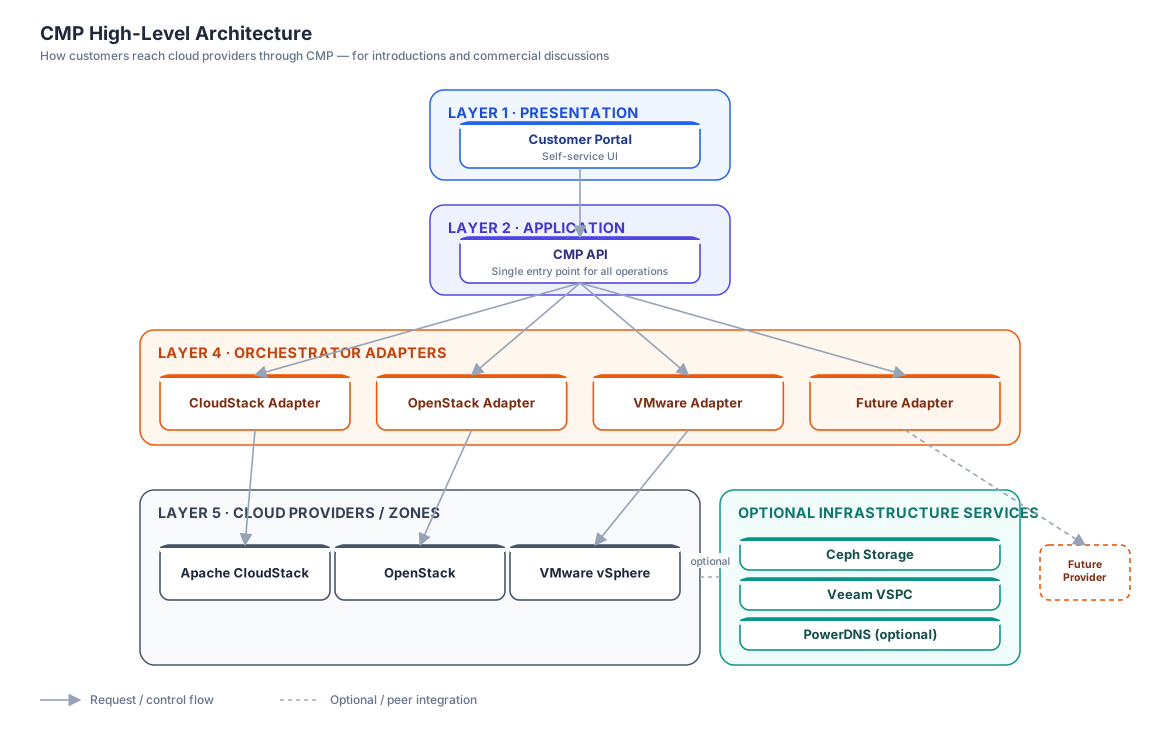
A simplified view of how customers reach cloud providers through CMP. Suitable for introductions and commercial discussions. Internal business modules are intentionally omitted.
Diagram
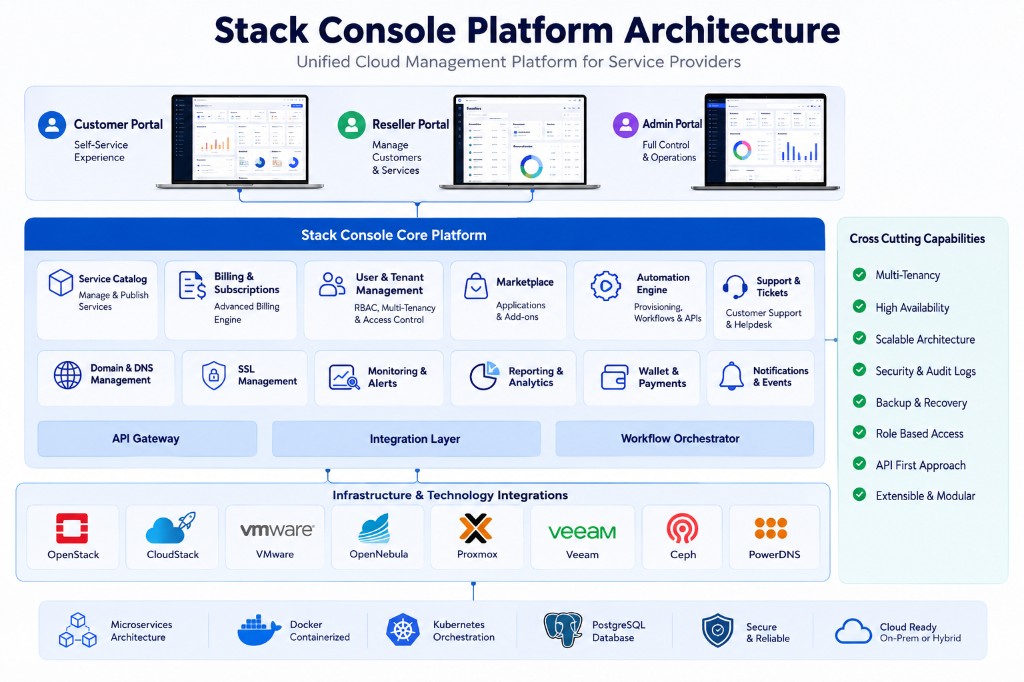
Platform architecture (product view)
Portals, core platform capabilities, infrastructure integrations, and technology foundation — useful for stakeholder and onboarding overviews.
Components
| Component | Role |
|---|---|
| Customer Portal | White-label self-service UI for end customers |
| CMP API | Single application entry for business operations |
| Cloud Adapters | Translate CMP operations into provider APIs |
| Cloud Providers | CloudStack, OpenStack, VMware control planes and zones |
| Optional services | Ceph (storage), Veeam VSPC (backup), PowerDNS (DNS) |
Data flow
- Customer actions enter at the Customer Portal.
- The portal calls the CMP API.
- The API selects the correct adapter for the customer’s provider and zone.
- The adapter invokes the cloud provider (and may use optional services such as Ceph or Veeam).
Design considerations
- Keeps commercial messaging simple: one portal, many clouds.
- Hides billing, RBAC, and module detail until the component view.
- Optional services are shown as peer infrastructure, not as primary compute providers.
Future extensibility
New providers still appear under Cloud Providers and behind a Future Adapter, but product delivery also needs portal, API, and business-service work for that provider’s workflows — not adapter wiring alone.
CMP Component Architecture
Architecture overview
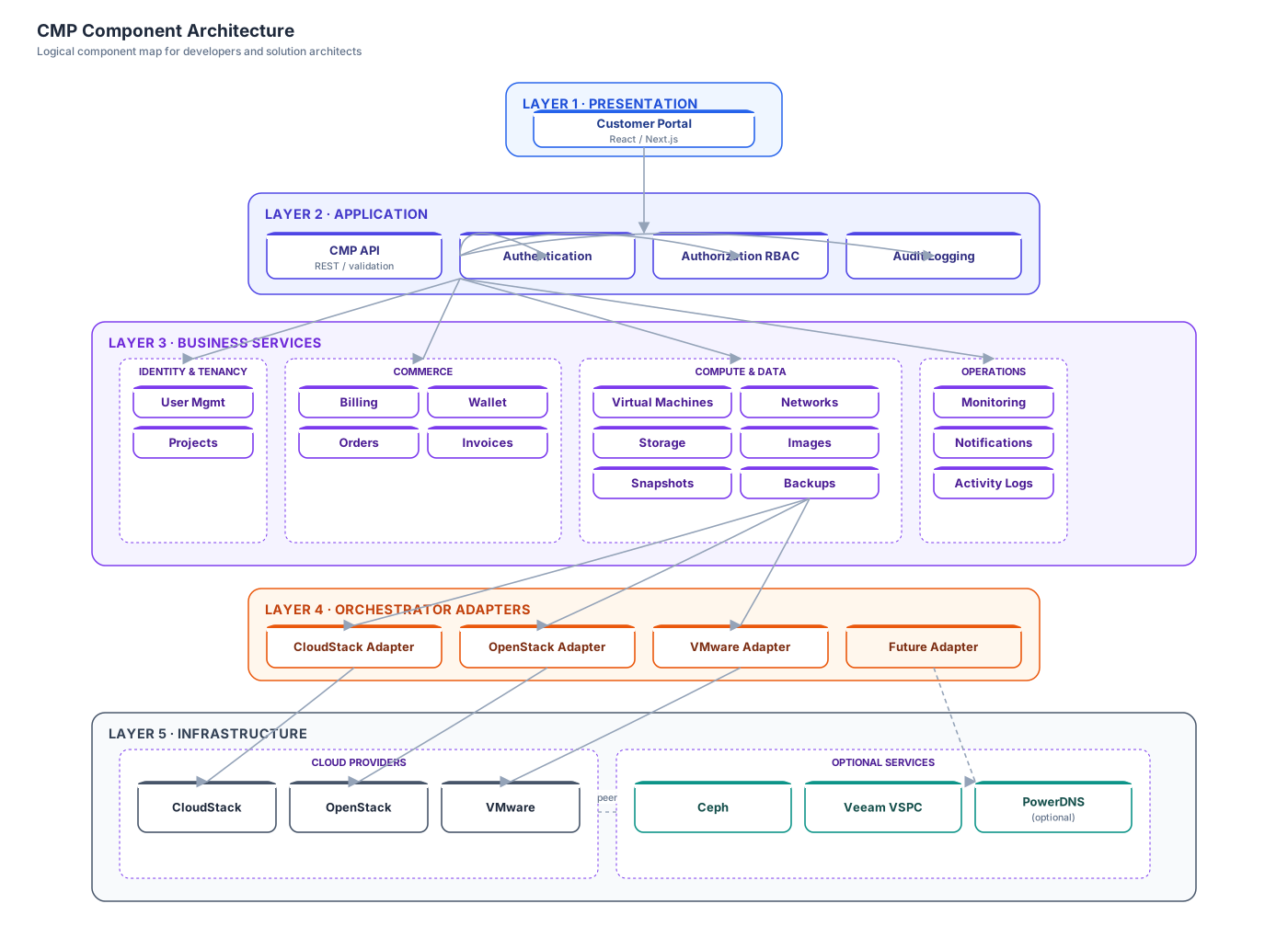
Full logical component map for developers and architects. Shows presentation, application cross-cutting concerns, business services, adapters, and infrastructure.
Diagram
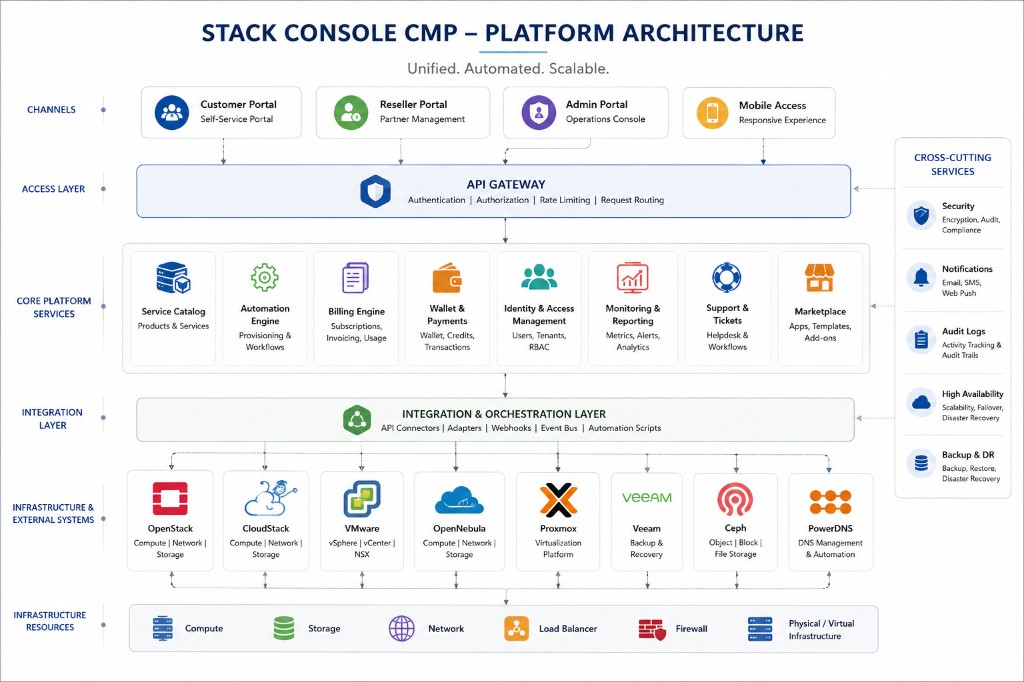
Layered platform architecture
Channels (Customer / Reseller / Admin portals), API gateway, core platform services, integration & orchestration, and connected infrastructure providers — aligns with the layered model in Architecture principles.
Components
| Layer | Components | Responsibility |
|---|---|---|
| Presentation | Customer Portal | Self-service UI, branding, responsive experience |
| Application | CMP API, Authentication, RBAC, Audit | Request entry, security, validation, audit trail |
| Business services | Users, projects, billing, wallet, orders, invoices, VMs, networks, storage, images, snapshots, backups, monitoring, notifications, activity logs | Domain logic and product features |
| Adapters | CloudStack, OpenStack, VMware, Future | Provider API translation |
| Infrastructure | Providers + Ceph, Veeam VSPC, PowerDNS (optional) | Actual cloud resources and optional services |
Data flow
- Portal submits an authenticated request to the CMP API.
- Authentication and RBAC authorize the action; audit logging records it.
- The matching business service executes (for example Virtual Machines or Billing).
- Infrastructure-affecting actions call the correct adapter.
- The adapter talks to the provider (and optional services when required).
- Results return through the API to the portal.
Design considerations
- Business modules stay as provider-agnostic as practical; adapters absorb API differences. New providers may still need business and UI changes for packages, quotas, and provider-specific flows.
- Billing, wallet, and invoices sit beside compute modules so commercial state is not locked inside a hypervisor API.
- Backup may use CloudStack-native paths or Veeam VSPC depending on configuration.
- PowerDNS remains optional and is not required for core IaaS.
Future extensibility
Implement a Future Adapter and register packages/zones for the new provider. Expect necessary changes in presentation, application, and business services as well — reuse shared modules where possible, but do not assume portal or billing need zero changes.
CMP Request Lifecycle
Architecture overview
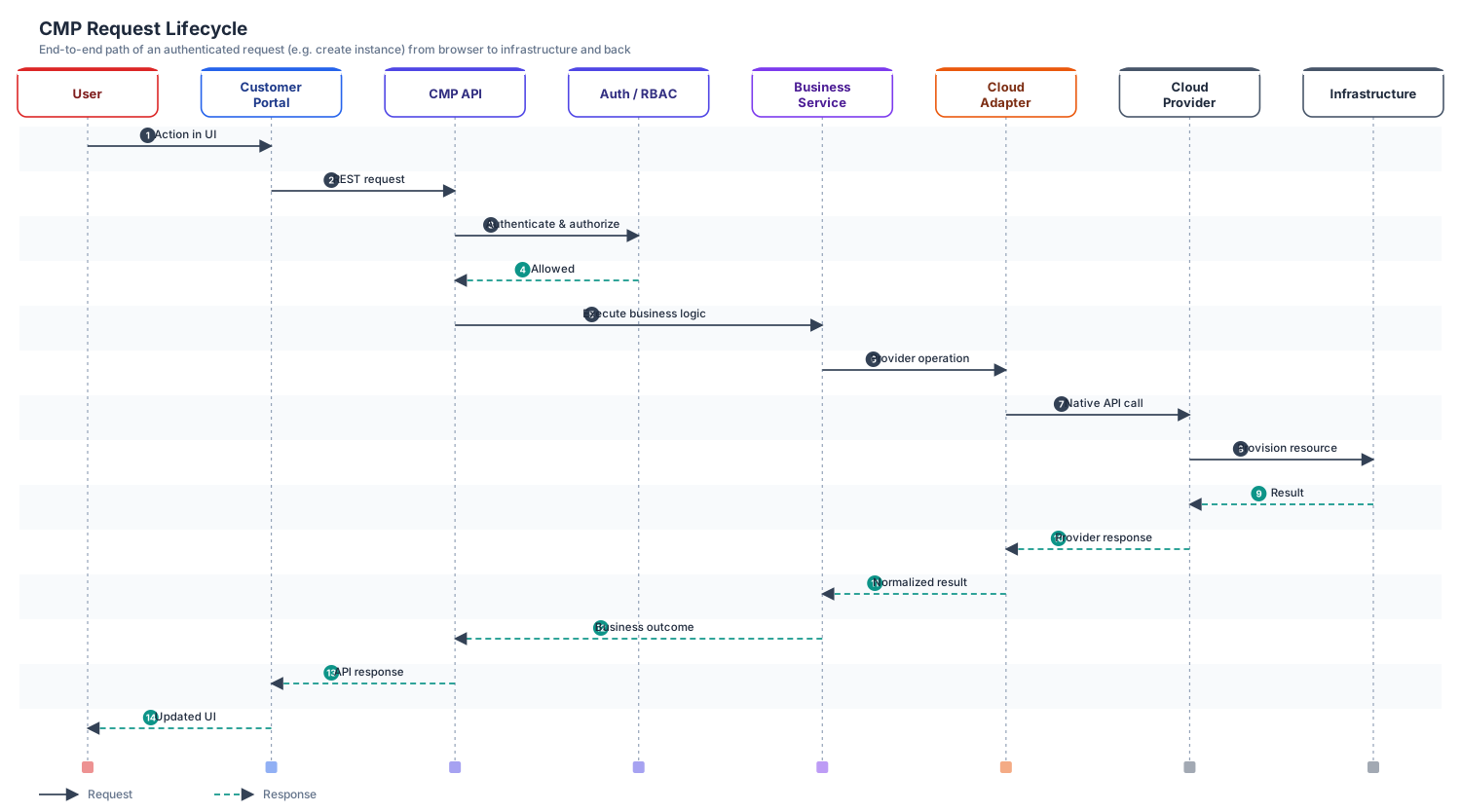
End-to-end path of a typical authenticated customer request (for example create instance) from browser to infrastructure and back.
Diagram
Components
| Step | Component | Responsibility |
|---|---|---|
| UI | Customer Portal | Capture intent, display result |
| API | CMP API | Validate payload, orchestrate services |
| Security | Authentication / RBAC | Identity and permission checks |
| Domain | Business service | Quotas, packages, billing hooks, state |
| Adapter | Cloud adapter | Map to CloudStack / OpenStack / VMware APIs |
| Provider | Control plane | Accept native API calls |
| Infrastructure | Hypervisor / storage / network | Apply the change |
Data flow
Linear top-down then reverse: User → Portal → API → Auth → Business → Adapter → Provider → Infrastructure, then response returns along the same path to the portal.
Design considerations
- Failures should surface at the API with actionable errors; adapters normalize provider-specific messages.
- Billing and quota checks typically run in the business service before the adapter call.
- Audit events should be written when authorization succeeds and when infrastructure mutations complete.
Future Extensibility
The request sequence shape stays the same (portal → API → business → adapter → provider). A new provider still needs adapter work and any presentation, application, and business-service changes required for that product’s standard workflows.
CMP Deployment Architecture
Architecture overview
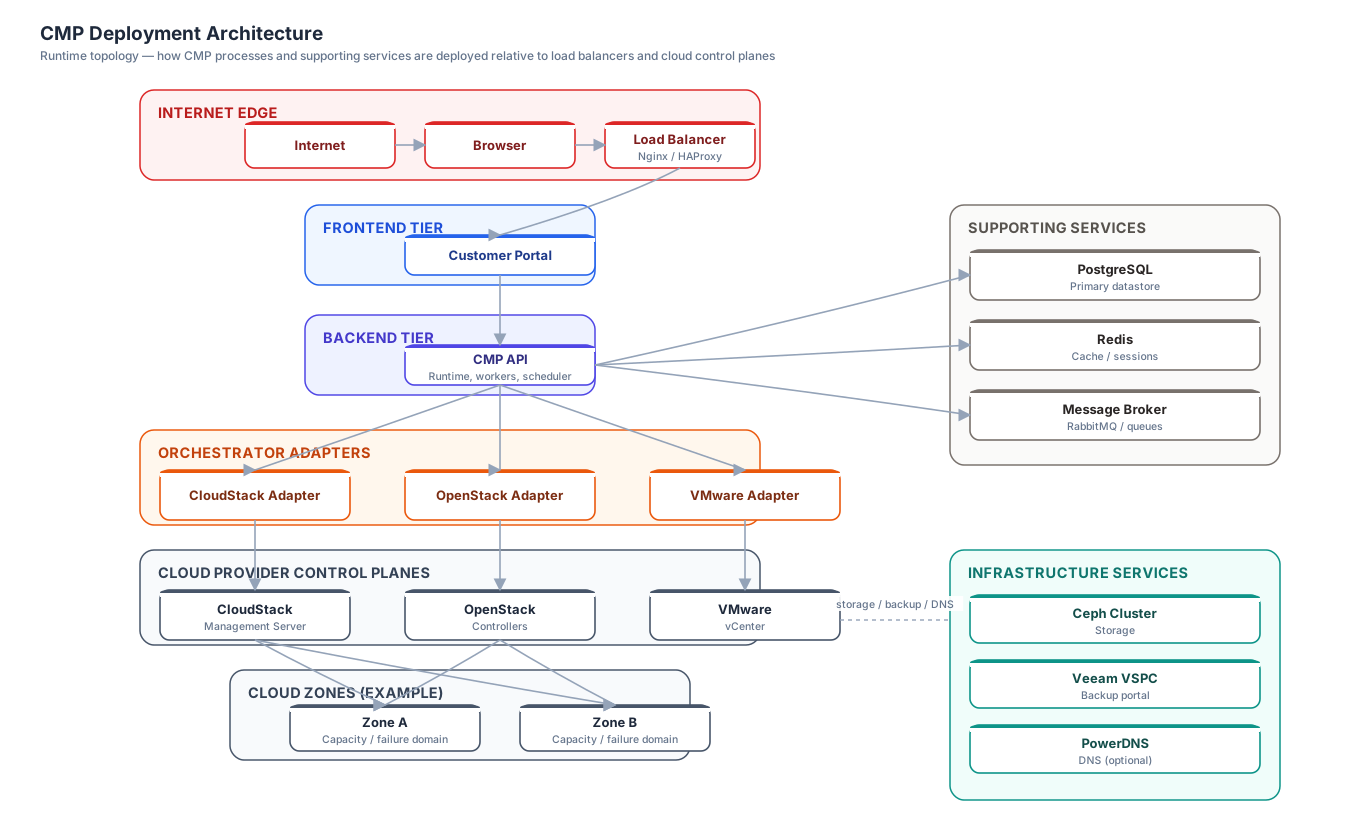
Runtime topology for operations and DevOps: how CMP processes and supporting services are deployed relative to load balancers and cloud control planes. This is the logical deployment view; concrete single-server and HA host layouts are in Choosing a Hosting Topology.
Diagram
Components
| Tier | Components | Responsibility |
|---|---|---|
| Edge | Internet, browser, load balancer | TLS termination, routing to frontend/API |
| Frontend | Customer Portal | Static/SSR portal delivery |
| Backend | CMP API | Application runtime, workers, schedulers |
| Supporting services | PostgreSQL, Redis, message broker | Persistence, cache, async jobs |
| Adapters | In-process or collocated with API | Provider integration |
| Control planes | CloudStack MS, OpenStack controllers, vCenter | Cloud management APIs |
| Infrastructure services | Ceph, Veeam VSPC, PowerDNS | Storage, backup portal, DNS |
| Zones | Zone A / B | Capacity and failure domains in the cloud |
Data flow
- Browser hits the load balancer.
- Portal and API traffic are routed to frontend and backend tiers.
- API reads/writes PostgreSQL, uses Redis, and enqueues work on the message broker when needed.
- Adapters call provider control planes; zones host customer workloads.
- Optional services (Ceph, Veeam, PowerDNS) are reached from providers or adapters per product design.
Design considerations
- Keep databases and brokers on private networks; expose only LB endpoints publicly.
- Message broker and Redis enable async billing, notifications, and long-running orchestrator jobs.
- Multi-zone clouds are represented under the provider; CMP maps packages to Cloud Provider + Zone.
- RabbitMQ (or equivalent queue) may be co-located with Redis-backed jobs depending on your CMP build — confirm with your StackConsole deployment package.
Future extensibility
Scale frontend and API horizontally behind the load balancer; add Redis/DB replicas; register new adapters without changing the edge topology. For host-level HA patterns, see Choosing a Hosting Topology.