IP Address packages — configure pricing
IP Address packages control how much public / network IPs cost on the rate card. The same package price is used for VM-create IPs, standalone IPs, and shared-network IPs (when billing is enabled on that network).
For when shared-network IP billing applies, see Shared Network IP Billing. Category overview: IP Address.
In CloudStack, reserving a specific IP for a specific account is a different concept. That account-level IP reservation is not supported in CMP. In this documentation, standalone IP means an IP the customer acquires separately in CMP — not CloudStack reserved-IP behaviour.
Unlike compute packages, IP packages do not map to a CloudStack offering ID. CMP acquires public IPs from CloudStack's IP pool and applies the pricing defined in the IP Address package for the relevant zone.
CMP allows only one IP Address package per Cloud Provider Setup + Zone combination. You cannot create multiple IP packages (for example, separate tiers or promotional packages) for the same setup and zone.
Free trials are not applicable to IP Address packages. The IP Address package form does not include Enable Free Trial — public IPs are always billed from the moment they are acquired or assigned. This is a common customer request; advise customers that free trial promotions apply to compute and other service packages, not to IP addresses.
Ensure the following are already configured:
- Cloud Provider Setup is connected, with IP Address enabled in Wizard Step 1
- Zones are mapped in CMP
- Public IP ranges are configured in CloudStack for the target zone
- You have an IP Address package for each setup + zone where you charge IPs (recommended: bill IPs separately — see
plan_ip_billing)
CMP path: Settings → Billing Setup → Rate Cards → Default → Packages → IP Address
For CloudStack Shared Networks, enable or disable IP billing and set IP Address Type on each network under Settings → Orchestrator → Networks. Pricing still comes from this package. See Shared Network IP Billing.
How IP billing works in CMP
Customers interact with public IPs in two ways:
| Scenario | Description |
|---|---|
| IP at VM creation | Customer provisions a VM and selects a public IP during Create Instance |
| Standalone IP | Customer purchases a public IP separately (IP Address section) and assigns it to a VM later |
CMP acquires the IP from CloudStack and bills according to your IP package pricing.
Billing modes (plan_ip_billing — deprecated)
plan_ip_billing is deprecatedThe global setting plan_ip_billing is deprecated. Do not rely on it for new designs.
- Default:
true - Recommended: Charge IP addresses separately via this IP Address package (and per-network IP billing where applicable — Shared Network IP Billing)
Leave the flag at true (or treat separate IP charging as the supported model). Bundling IP cost into the VM package (false) is legacy behaviour only.
Historical behaviour of the flag (for existing portals that still expose it):
| Mode | Configuration | Behaviour |
|---|---|---|
| IP charged separately (default / recommended) | plan_ip_billing = true | A separate IP charge applies when a VM is created with a public IP |
| IP included in VM package (legacy) | plan_ip_billing = false | Public IP cost is rolled into the VM package price — no separate IP line item if the customer opts for a public IP at VM create |
Standalone IPs purchased separately are always billed through the IP Address package regardless of this flag.
Billing lifecycle
- IP billing starts when the IP is assigned to a VM or acquired as a standalone IP
- IP billing continues even when the VM is stopped — unlike CPU and RAM, which pause under stoppable-service billing
- IP billing stops when the IP is released or deleted
Source NAT IP reuse (isolated networks)
On isolated networks, CMP reuses the network's Source NAT public IP for the first VM that requests public access:
- First VM with public access — CMP uses the isolated network's Source NAT IP and associates it via port forwarding. The IP is charged per your Network package.
- Additional VMs with public access (Create Instance) — CMP acquires a new public IP and charges for it. Association uses Static NAT or Port Forwarding per Cloud Provider Setup Default Network Strategy. Manual IP association outside Create Instance is chosen by the customer. On isolated networks, the first (Source NAT) IP always uses Port Forwarding — see Networks — Isolated Networks and Source NAT.
- VM deletion (Source NAT case) — CMP disassociates the IP from the VM but retains it on the network. Source NAT IPs are deleted only when the network is deleted (CloudStack behaviour) — see VPC — Source NAT IP and deletion and Isolated Network — Source NAT reuse.
- Reuse — If the Source NAT IP is not associated with any VM, CMP reuses it for the next VM that requests public access.
The VPC Source NAT IP cannot be used for Vm or any load balancer rules in CloudStack. Using Source NAT will fail at the CloudStack layer. See Load Balancer — VPC Source NAT and load balancing.
CloudStack prerequisites
Public IPs must be available in CloudStack before customers can acquire them through CMP.
- Log in to the CloudStack UI with admin privileges
- Navigate to Infrastructure → Zones → [your zone] → Physical Networks
- Confirm public IP ranges are configured and have available addresses
- Verify VLAN or network setup allows IP allocation for isolated and VPC networks
- Test manual IP acquisition from the CloudStack UI before enabling customer self-service
No separate CloudStack "IP offering" is required — CMP manages IP allocation through the CloudStack API.
Configure IP Address packages in CMP
Create one IP Address package per Cloud Provider + Setup + Zone where you want defined IP pricing. CMP does not support multiple IP packages for the same setup and zone, and free trials cannot be enabled on IP Address packages.
- Open Settings → Billing Setup → Rate Cards → Default → Packages → IP Address
- Click Add Package (form title: Create IP Address Package)
- Complete each field below in the order shown on the form
- Set Status to Active and save
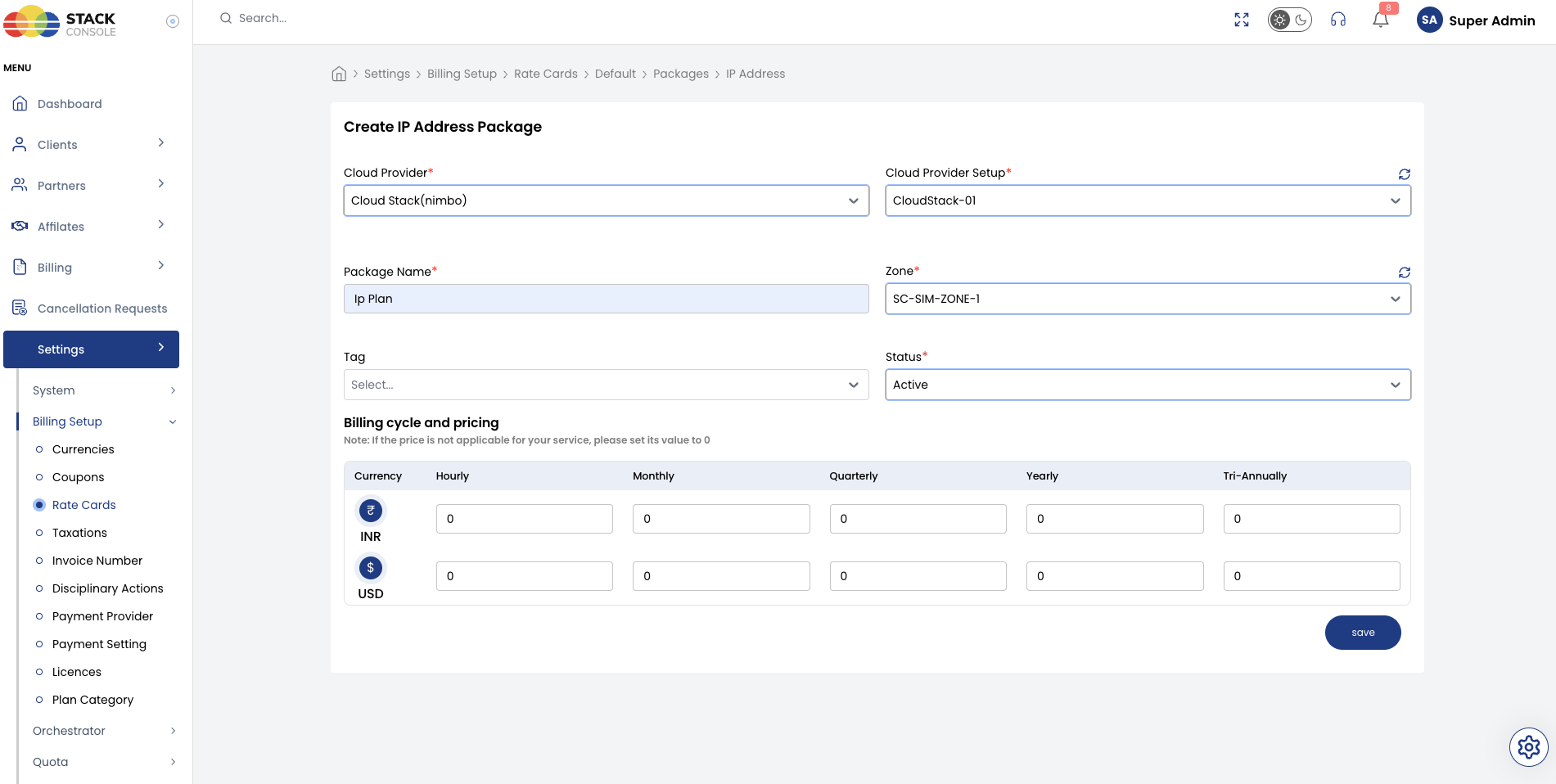
Each field below matches the Create IP Address Package form.
Cloud Provider
Required. Select the orchestrator type — for example, CloudStack (Nimbo).
Cloud Provider Setup
Required. Select the CloudStack instance this package belongs to — for example, CloudStack-01.
CMP supports one IP Address package per Cloud Provider Setup + Zone. Create separate entries if you operate multiple setups or zones.
Package Name
Required. Display name for the IP service — for example, Ip Plan or Public IP Address.
Zone
Required. Select the CMP zone where this IP pricing applies. IP charges are scoped to the zone where the IP is acquired — for example, SC-SIM-ZONE-1.
Tag
Optional. Assign a tag for filtering or promotional labelling in the customer portal.
Tags are CMP-level labels used for representation only. They do not map to CloudStack host or storage tags.
Status
Required. Controls package visibility.
| Status | Behaviour |
|---|---|
| Active | IP pricing applies when customers acquire public IPs in this zone |
| Inactive | Hidden — use while configuring pricing or testing |
Billing cycle and pricing
Required. Set the price for each billing cycle and currency CMP supports.
IP addresses are typically priced per IP per month or per IP per hour. Enter values for each billing cycle you offer.
Define the monthly price first, then derive hourly using Monthly ÷ (30.5 × 24). See Pricing Formulas.
With the recommended model (IPs charged separately; deprecated plan_ip_billing default true), this package pricing applies to IPs acquired at VM creation and to standalone IPs. The legacy plan_ip_billing = false path mainly used this package for standalone IPs only.
The Create IP Address Package form does not include Enable Free Trial. Public IPs are always billed from acquisition — see the critical note at the top of this page.
End-to-end example
Goal: Charge $5/month per public IP separately from VM pricing in zone SC-SIM-ZONE-1.
CMP global settings
- Prefer separate IP charging (recommended). The deprecated flag
plan_ip_billingdefaults totrue— leave it attrueif still present in Global Settings
CMP package
- Open Packages → IP Address → Add Package
- Set Cloud Provider CloudStack (Nimbo), Cloud Provider Setup
CloudStack-01, Package NameIp Plan, ZoneSC-SIM-ZONE-1 - Enter pricing — for example, USD monthly
5.00, hourly derived automatically - Set Status to Active and save
Customers creating a VM with a public IP or purchasing a standalone IP are charged per this package.
Customer portal view
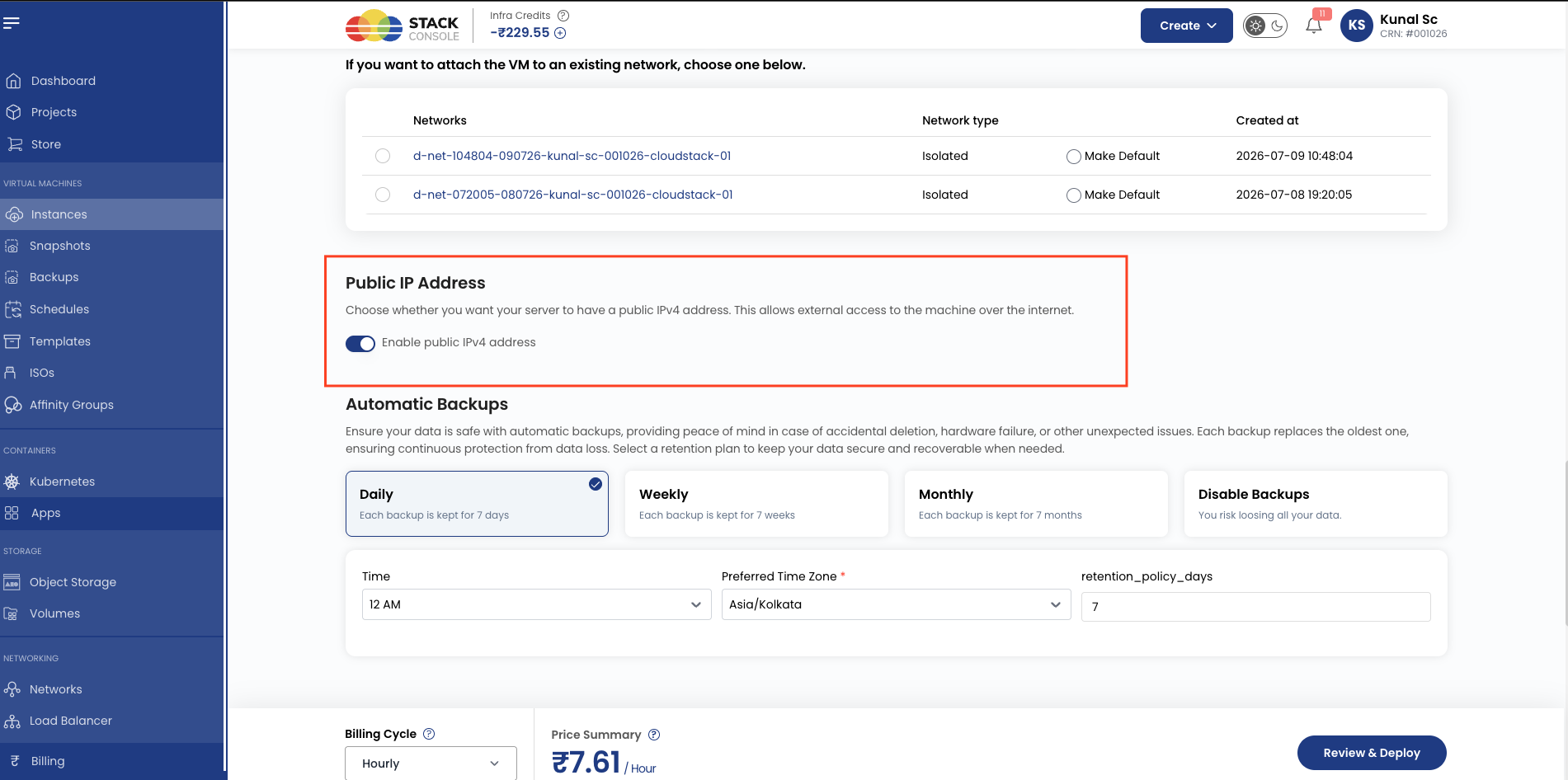
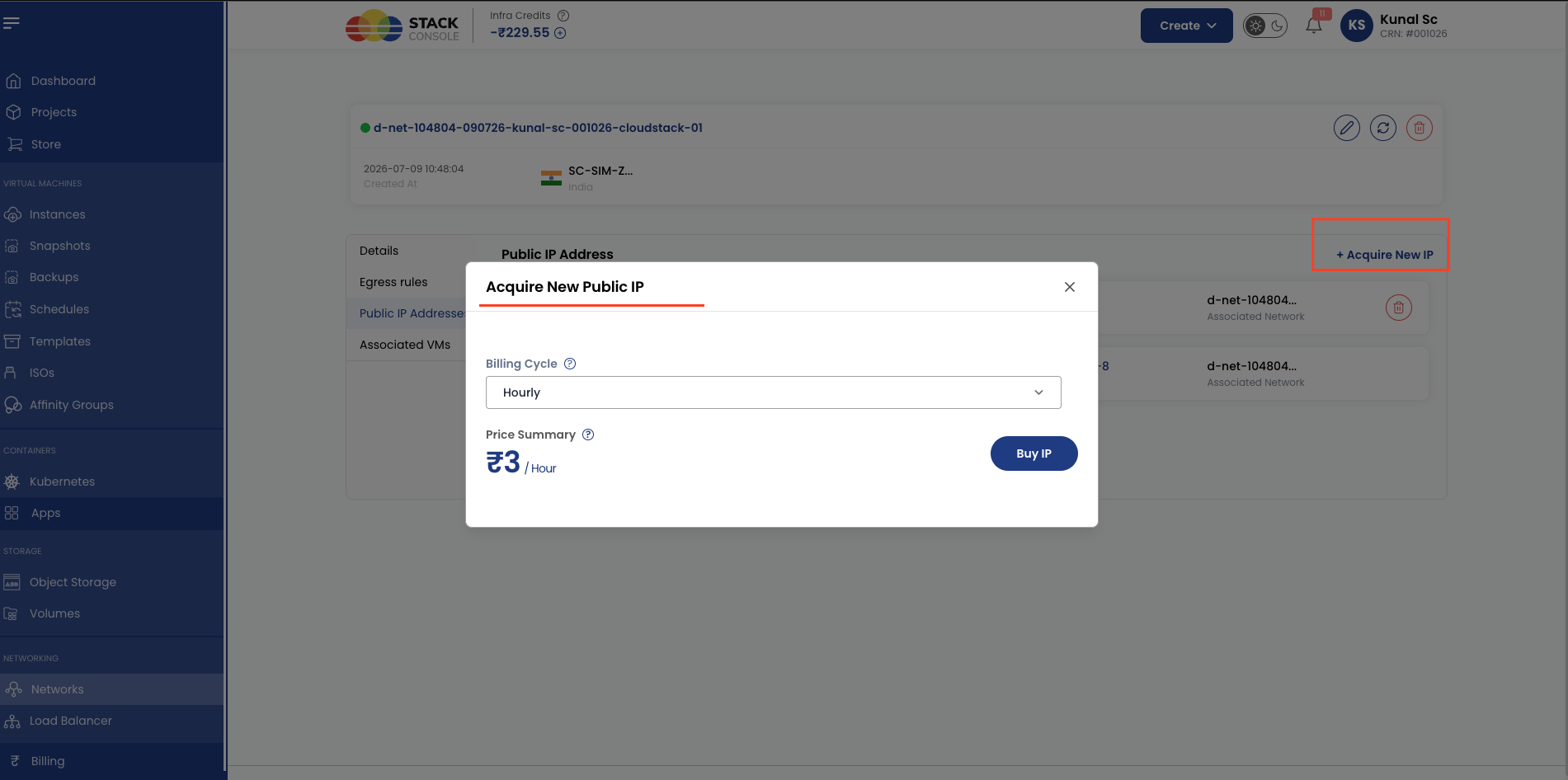
Customers acquire IPs during Create Instance (public IP option) or from the IP Address section for standalone IPs.
Customers often ask whether public IPs can be included in a free trial. They cannot. IP Address packages do not support free trials — any public IP acquired or assigned is billed immediately per the zone's IP package pricing, even if the associated VM is on a free trial.
At the time of VM Creation
From network section
Validation checklist
Before marking an IP Address package Active, verify:
- IP Address service is enabled in Cloud Provider Setup (Wizard Step 1)
- Public IP ranges are configured and have available addresses in CloudStack for the target zone
- IPs are charged separately via this package (recommended); if
plan_ip_billingstill appears in Global Settings, leave it at defaulttrue(flag is deprecated) - Pricing is configured for each supported currency and billing cycle
- Global quotas allow sufficient IP Address count per account
- CloudStack IP quota limits are set high enough — see Quota Management (ACS)