Prepaid
In prepaid mode, customers must maintain a wallet balance. Usage is deducted in real time. Customers can top up manually, or use Auto Pay (when enabled) to charge a saved payment method when balance falls below a threshold.
Set payment mode: Clients → Register Client (Step 2 — new onboarding) or Clients → [Customer] → Billing Setup (existing account)
Admin onboarding
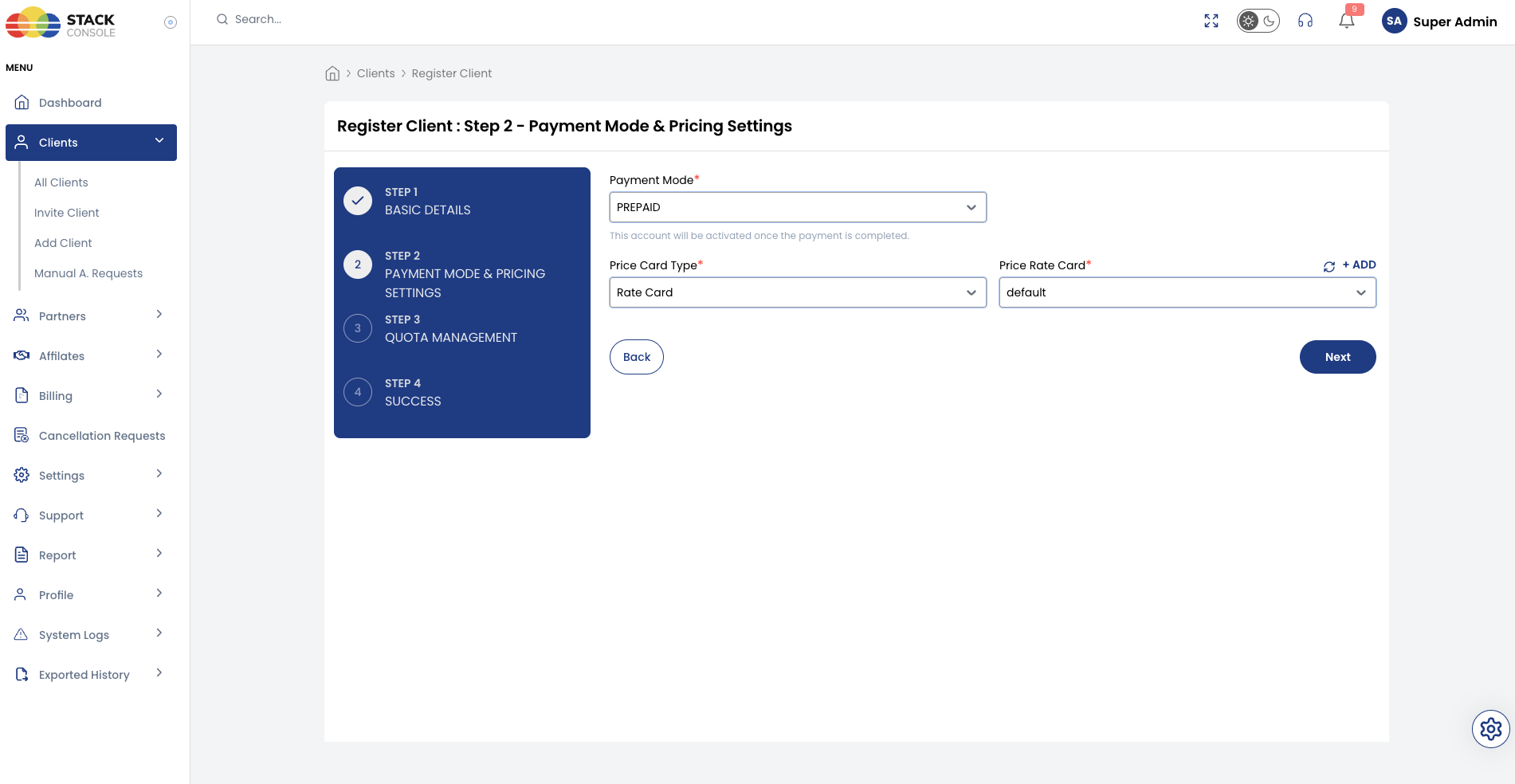
Admin selects PREPAID when onboarding a customer via Clients → Register Client.
| Step | Action |
|---|---|
| 1 | Basic Details — enter customer information |
| 2 | Payment Mode & Pricing Settings — select PREPAID, assign Price Rate Card |
| 3 | Quota Management — assign quotas |
| 4 | Success — customer must complete initial wallet payment to activate |
See Admin registration flow and Step 2 — Prepaid (admin).
Self-registration
Customers can select PREPAID on the public signup form when prepaid is enabled for Customer in Payment Mode Settings.
| Step | Action |
|---|---|
| 1 | Verify Email Address |
| 2 | Complete Payment — select PREPAID, choose top-up amount, pay via gateway |
On Step 2, the customer selects I want my account to be → PREPAID, picks a Select Amount (infra credits), and pays through the configured gateway. Account activates after payment.
| Rule | Behaviour |
|---|---|
| Service creation | Blocked if insufficient — CMP shows insufficient infra credit message; top up wallet to proceed |
| Service renewal | Auto-renews if balance sufficient; otherwise unpaid invoice + negative wallet |
| Wallet top-up | Manual, or Auto Pay when enabled and a payment method is saved |
| Hourly services | Model 1: wallet deducted only. Model 2: wallet deducted + monthly service invoice on 1st |
| Fixed-cycle services | Full period charged from wallet at creation |
Service creation
| Wallet balance | Result |
|---|---|
| Sufficient | CMP allows service creation |
| Insufficient | Service creation is blocked — CMP shows an insufficient infra credit message. No invoice is generated. After the customer adds sufficient infra credit / wallet balance, they can create the service |
Service renewal
| Wallet balance | Result |
|---|---|
| Sufficient | CMP automatically renews the service |
| Insufficient | CMP generates an unpaid invoice, marks it unpaid, and wallet balance may go negative |
Renewal invoices are generated in advance for all billing cycles except hourly.
Prepaid invoice payment workflow
In CMP prepaid billing, the invoice due date is configured as Immediate. When CMP generates an invoice (e.g. for service purchases, scheduled renewals, or fixed-cycle packages), the system immediately attempts to settle the invoice amount using the customer's available wallet balance.
Scenario 1: Sufficient wallet balance
If the customer has sufficient funds in their wallet when the invoice is generated, CMP automatically marks the invoice as Paid and deducts the invoice amount from the wallet balance.
Example:
| Parameter | Value |
|---|---|
| Initial wallet balance | ₹200 |
| Invoice amount | ₹150 |
| Invoice status | Paid |
| Remaining wallet balance | ₹50 |
Scenario 2: Insufficient wallet balance (Negative balance)
If the customer's wallet balance is insufficient to cover the invoice amount at renewal or during ongoing service consumption, CMP marks the invoice as Unpaid, and the customer's wallet balance becomes negative to reflect the outstanding amount owed.
Example:
| Parameter | Value |
|---|---|
| Initial wallet balance | ₹100 |
| Invoice amount | ₹150 |
| Invoice status | Unpaid |
| Wallet balance | -₹50 |
What happens when the customer adds funds?
When the customer adds funds (tops up) to their wallet, CMP checks whether the available balance is sufficient to settle outstanding unpaid invoices. If sufficient funds are available, the invoice is automatically marked as Paid, and the invoice amount is settled from the wallet balance.
Continuing the example from Scenario 2:
| Step | Status / Amount |
|---|---|
| Wallet balance after invoice generation | -₹50 |
| Funds added by the customer | +₹100 |
| Invoice status after settling | Paid |
| Remaining wallet balance | ₹50 |
This automated clearing workflow ensures that outstanding invoices are settled automatically once sufficient funds become available in the customer's wallet, without requiring manual administrative action.
Understanding negative wallet balances ("No negative balance" policies)
Providers often ask: “Can we prevent customers from having a negative account balance?”
In CMP, a negative wallet balance functions as an intentional financial ledger reflection of unpaid renewal invoices or ongoing hourly consumption, rather than a system defect:
- Service creation is strictly protected: Customers cannot create a new service into a negative balance. If wallet funds are insufficient, CMP blocks provisioning immediately and displays an
insufficient infra crediterror. - Renewal and uptime continuity: If an existing workload (e.g., an active production VM, database, or network IP) is up for renewal and the customer's wallet is short on funds, instantly shutting down or destroying the workload at minute zero would lead to catastrophic data loss and service disruption. Instead, CMP generates an Unpaid invoice, marks the deficit on the wallet (negative balance), and starts the account grace period.
- Provider enforcement controls: If your cloud business model requires strictly preventing or minimizing negative balance exposure:
- Immediate Freeze on Day 0: In Disciplinary Actions — Freeze, set The no. days after the … action to be applied for FREEZE to
0. The moment the wallet balance becomes negative, CMP immediately freezes customer resources on Day 0. - Low Infra Credit Notifications: Configure multi-tier threshold alerts (e.g., ₹500, ₹200, ₹50) so customers receive automated notifications to replenish their wallet before balance is exhausted.
- Auto Pay: Allow customers to attach a saved card so CMP automatically tops up their wallet before the balance drops below a predefined threshold.
- Immediate Freeze on Day 0: In Disciplinary Actions — Freeze, set The no. days after the … action to be applied for FREEZE to
Wallet balance management
Adding funds to the wallet is a manual process. There is no automated card charging or recurring top-up mechanism built into standard prepaid mode (customers must manually initiate a top-up through the portal, unless the optional Auto Pay feature is specifically enabled):
- Manual top-up — customer adds funds through the payment gateway when balance is low
- Auto Pay — when the global
autopaysetting is enabled, customers can save a payment method and set a balance threshold plus top-up amount; CMP charges that method when balance falls to or below the threshold - On top-up, any negative balance is cleared first before crediting usable balance
- Usage charges are deducted from the wallet in real time
| Service type | Wallet behaviour |
|---|---|
| Hourly (PAYG) | Balance reduces continuously as the service runs |
| Monthly / quarterly / yearly | Full period deducted at service creation |
Example (hourly): Wallet ₹5,000 → VM ₹10/hour × 100 hours → wallet ₹4,000
Example (monthly): Wallet ₹5,000 → monthly VM ₹3,000 → wallet ₹2,000 immediately
Low balance handling
When wallet balance reaches zero or goes negative:
- CMP sends a notification alert to the customer
- Usage tracking may continue; balance may go negative
- On next top-up, the negative balance is cleared first
- If negative beyond the grace period, disciplinary actions apply
Disciplinary actions
If the wallet remains negative beyond the configured grace period, CMP triggers disciplinary actions (freeze, suspend, terminate) as configured in global or account settings.
Full documentation: Disciplinary Actions.
Assigning payment mode
Payment mode is set when the account is created. For admin onboarding, see Admin registration flow. For self-registration, see Self-registration flow.
Payment mode is effectively fixed after onboarding for prepaid and postpaid accounts. The only conversion path is Manual → Postpaid, which happens automatically when a manual customer saves a card:
| Conversion | Supported? | How |
|---|---|---|
| Prepaid → Postpaid | ❌ Not supported | Adding a card does not convert prepaid accounts |
| Prepaid → Manual | ❌ Not supported | — |
| Postpaid → Prepaid | ❌ Not supported | — |
| Postpaid → Manual | ❌ Not supported | — |
| Manual → Postpaid | ✅ Supported | Automatic when customer saves a credit or debit card |
Plan the correct payment mode before customers provision services. See Payment Modes — Changing payment mode.
Prepaid billing models — end-to-end workflow
Prepaid is wallet-based — the primary financial event may be wallet top-up (infra credits) or each service usage, depending on your tax and accounting rules. CMP supports two prepaid billing models.
| Model 1 | Model 2 | |
|---|---|---|
| Name | Invoice against infra credits | Invoice against service usage |
| Also called | Invoice for wallet transactions | Receipt for wallet + invoice for services |
| Wallet top-up | Invoice generated | Receipt generated |
| Service usage | Tracked internally — not invoiced | Invoice per usage event / renewal / monthly hourly total |
| Best when | Tax rules treat wallet funding as the main transaction (required for Indian providers) | GST, VAT, or e-invoicing requires invoices per service consumption |
Configure prepaid billing model
The active model is set globally in Admin Panel → Global Settings:
| Setting | Category | Value | Billing model |
|---|---|---|---|
generate_prepaid_reciept | Billing | false | Model 1 — invoice against infra credits (wallet top-up generates an invoice; service usage is not invoiced) |
generate_prepaid_reciept | Billing | true | Model 2 — invoice against service usage (wallet top-up generates a receipt; each service event generates an invoice) |
To verify the live value on this portal without opening Global Settings, use admin Billing → Invoices → Billing Settings.
Description in CMP: For prepaid accounts, if true the system generates invoices for services, otherwise it generates invoices for adding infra credit (wallet funds).
For Indian cloud providers, set generate_prepaid_reciept = false (Model 1 — invoice against infra credits). This is the required prepaid billing model for India deployments.
Under Indian GST practice, the payable invoice is issued when the customer purchases infra credits (wallet top-up). Service usage is tracked and deducted from the wallet but is not invoiced separately. Model 2 (service invoices) is not supported for Indian prepaid workflows — it can cause billing confusion between infra-credit invoices and service invoices.
Configure generate_prepaid_reciept during initial platform setup — before onboarding prepaid customers or enabling self-registration. This flag applies platform-wide to all prepaid accounts. Changing it after customers and services exist can cause billing inconsistencies.
Decide the prepaid billing model before going live using generate_prepaid_reciept in Global Settings (see Configure prepaid billing model). Switching models after customers and services exist can cause billing inconsistencies for existing accounts.
Model 1 — Invoice against infra credits
Wallet top-up is the only invoice. Service creation, renewal, and hourly usage deduct the wallet but do not generate service invoices. Usage is recorded internally for reporting.
Monthly service example
Customer creates a monthly VM costing ₹1,000/month.
Step 1 — Add infra credits
- Customer adds ₹5,000 to the wallet
- CMP generates Invoice #1 for ₹5,000 (wallet top-up / infra credits purchase)
- Wallet balance = ₹5,000
Step 2 — Create service
- Customer creates the monthly VM
- CMP checks wallet balance
- ₹1,000 deducted immediately
- Wallet balance = ₹4,000
- No new invoice generated
Step 3 — Service renewal
- Next month the VM renews
- Another ₹1,000 deducted
- Wallet balance = ₹3,000
- No renewal invoice generated
Hourly service example
Step 1 — Add infra credits
- Customer adds ₹5,000 to the wallet
- CMP generates one wallet top-up invoice for ₹5,000
Step 2 — Create and run hourly VM
- Customer creates an hourly VM
- Throughout the month, hourly usage is deducted from the wallet
- No service invoice generated for hourly consumption
Model 1 summary
| Event | Invoice? | Wallet deducted? |
|---|---|---|
| Wallet top-up | ✅ Yes | — (credited) |
| Service creation (monthly) | ❌ No | ✅ Yes |
| Service renewal (monthly) | ❌ No | ✅ Yes |
| Hourly usage | ❌ No | ✅ Yes (continuous) |
| Service usage tracking | Recorded internally for reporting — customers see full history on Usage Details (Model 1) | — |
Model 2 — Invoice against service usage
Wallet top-up generates a receipt (not an invoice). Every billable service event generates a service invoice in addition to wallet deduction.
Monthly service example
Step 1 — Add infra credits
- Customer adds ₹5,000 to the wallet
- CMP generates a receipt (not an invoice)
- Wallet balance = ₹5,000
Step 2 — Create service
- Customer creates a monthly VM costing ₹1,000
- Wallet balance verified
- ₹1,000 deducted immediately
- Wallet balance = ₹4,000
- CMP generates a service invoice for ₹1,000
Step 3 — Renewal
- On renewal, another ₹1,000 deducted
- Wallet balance = ₹3,000
- CMP generates another service invoice for ₹1,000
Hourly service example
Step 1 — Add infra credits
- Customer adds ₹5,000
- CMP generates a receipt
Step 2 — Create and run hourly VM
- Customer creates an hourly VM
- Usage collected throughout the month (wallet deducted continuously)
Step 3 — Month-end invoicing (1st of next month)
- Total hourly usage calculated
- Wallet balance deducted for the period total
- CMP generates a monthly service invoice for total hourly usage
Model 2 summary
| Event | Receipt / invoice? | Wallet deducted? |
|---|---|---|
| Wallet top-up | Receipt | — (credited) |
| Service creation (monthly) | Service invoice | ✅ Yes |
| Service renewal (monthly) | Service invoice | ✅ Yes |
| Hourly usage (monthly) | Service invoice on 1st of next month | ✅ Yes |
| Service usage tracking | Every billable usage is invoiced — open (not-yet-invoiced) lines appear on Usage Details (Model 2) | — |
Which model should you select?
| Choose Model 1 if… | Choose Model 2 if… |
|---|---|
| Indian providers — required; payable invoice on wallet top-up (infra credits) | Local regulations require an invoice for each billable service or renewal |
| Accounting or tax rules treat wallet funding (infra credit purchase) as the primary financial transaction | VAT or e-invoicing (outside India) requires invoices based on actual service consumption |
| Service usage only needs internal tracking and wallet deduction | Typical for EU VAT per-service, Latin America e-invoicing |
| Region | Required / typical model |
|---|---|
| India | Model 1 — generate_prepaid_reciept = false. Invoice on infra credit purchase; no service invoices |
| European Union | Model 2 — invoice per service for VAT; wallet top-up may be receipt only |
| Latin America (Mexico, Brazil, Chile) | Model 2 — e-invoicing per taxable event |
| Fiscalization countries (France, Spain) | Model 2 — real-time service-based invoicing |
Configure the applicable model for your deployment with your StackConsole / tax advisor before launch.
Hourly and fixed-cycle services (both models)
Wallet deduction behaviour is the same in both models. Invoice generation differs — see Model 1 and Model 2 above.
Fixed cycles (monthly, quarterly, yearly)
- Wallet balance checked at service creation
- Full period amount deducted immediately from wallet
- If wallet insufficient → service not created
- Model 1: no service invoice. Model 2: service invoice generated at creation and each renewal
Hourly (pay-as-you-go)
- Wallet deducted continuously as the service runs
- Model 1: no service invoice — wallet top-up invoice only
- Model 2: consolidated service invoice on the 1st of the next month for total hourly usage
VM upgrade billing (prepaid)
Hourly services
| Period | Charging |
|---|---|
| Before upgrade | Original package hourly rate — immediate invoice generated |
| After upgrade | New package hourly rate from upgrade moment to month end |
Monthly and other fixed cycles
Prorated adjustment calculated from upgrade date to end of billing period.
Example — monthly billing:
| Item | Value |
|---|---|
| Original package | $100/month |
| Upgrade date | 12th of month |
| New package | $150/month |
| Proration base | 30.5 days |
Old daily rate     = $100 ÷ 30.5 ≈ $3.28/day
Used (12 days)     = 12 × $3.28 = $39.36
Remaining old (18d) = 18 × $3.28 = $59.04
New daily rate     = $150 ÷ 30.5 ≈ $4.92/day
New portion (18d)  = 18 × $4.92 = $88.56
Upgrade adjustment = $88.56 − $59.04 = $29.52
Prepaid upgrade invoicing:
- A separate payable invoice is created for each upgrade
- Example: invoice on 1st for $100 (full month); on 12th upgrade, new invoice for $29.52 adjustment
Early deletion before cycle ends
| Billing cycle | Charge on early delete |
|---|---|
| Hourly | Pay only for hours used (creation to deletion) |
| Monthly / quarterly / yearly | Full period still charged — no refund. Admin may grant free credits if customer disputes |
Service contracts on prepaid
Prepaid accounts support Service Contracts for quarterly and longer billing cycles with DATE_TO_DATE:
- Monthly wallet deduction: Instead of collecting the entire multi-month or annual price upfront, CMP deducts the discounted monthly installment from the customer’s infra credit wallet on each monthly anniversary.
- Deletion protection: Customers cannot immediately destroy a contract service. They can only choose End of billing period before the configured Cancellation Deadline.
- Billing rule configuration: On Settings → Billing Setup → Update Billing Rule, open the Prepaid tab and set Contract Status = Enable on the desired long cycles (Quarterly, Yearly, etc.).
See Service Contracts Overview and Calculations & Lifecycle.
Related
- Service Contracts
- Usage Details — how Model 1 vs Model 2 appear on the customer Account Statement
- Billing Settings (admin) — see current
generate_prepaid_recieptand enabled modes - Low Infra Credit Notifications — prepaid-only wallet threshold alerts
- Payment Modes
- Billing Cycles
- Pricing Formulas